
Be the business they find, and the one they choose.
Small business SEO services that grow your AI and search visibility, sharpen your content, and keep your site improving every month.

Easier to find. Easier to understand. Easier to choose.
SEO, content, design and updates, fixed together instead of as separate problems.
What we help improve
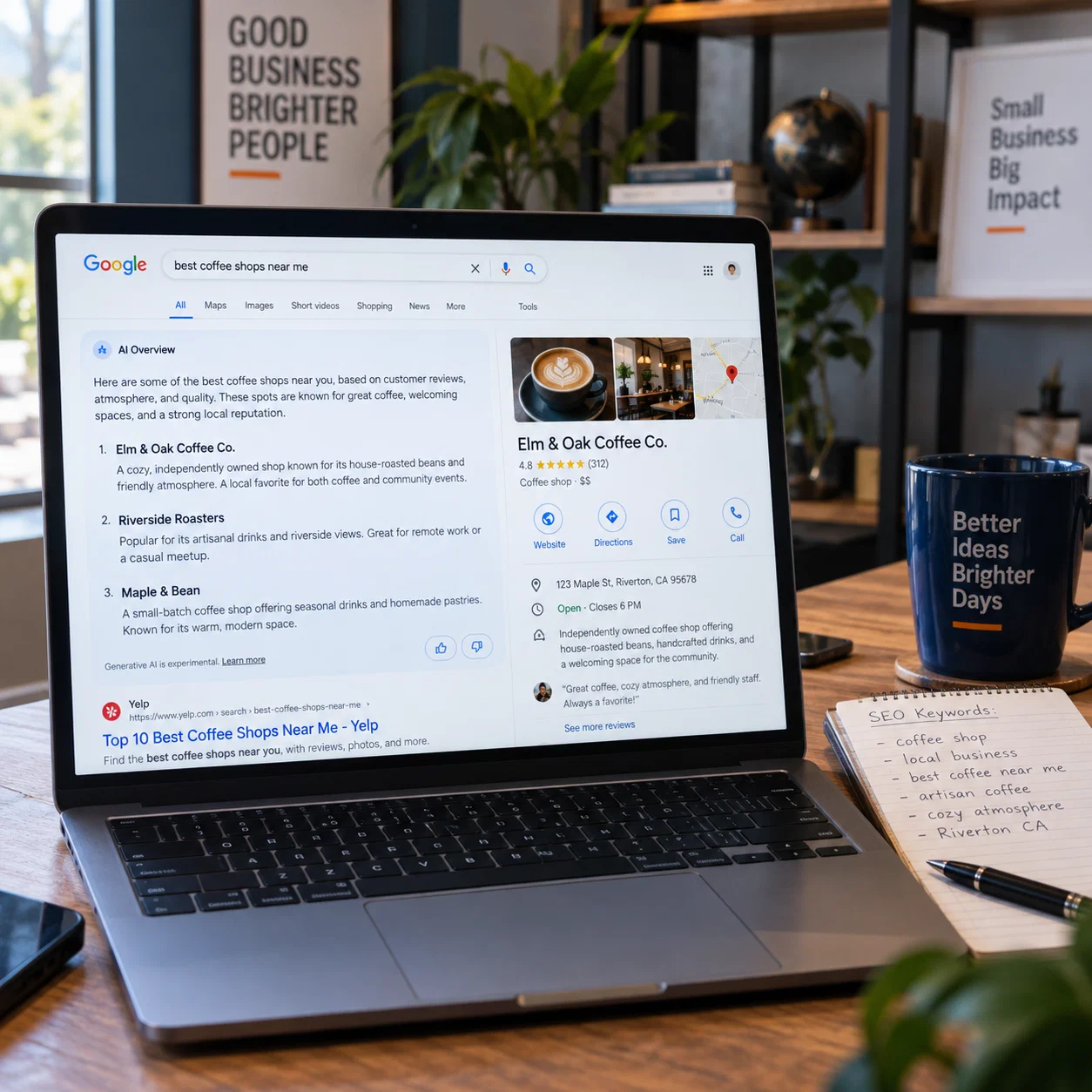
AI and search visibility
Structure, relevance and local signals that show up in Google and AI answers.

UI & UX improvements
Clearer layouts, stronger CTAs and a mobile experience that converts.
Content marketing for small businesses
Service pages, blog topics and refreshes that earn trust before the first call.
Monthly website updates
Steady improvements every month, so your site never falls behind.
Watch
What happens in a free SEO audit
A short walkthrough of what we review, how AI speeds up the research, and how you get a clear list of what to fix first.
Free SEO audit walkthrough
Video coming soonNot a huge agency. A practical growth partner.
Consistent help on the parts of your site that move visibility and leads. No random activity.
- Stronger AI and search visibility
- Outdated sites that need better UX and messaging
- Ideas turned into useful content
- Ongoing monthly updates, not one-off fixes
How we work
- 1
Review
Where your site stands in search, AI, content and UX.
- 2
Prioritize
The few fixes that move the needle first.
- 3
Improve
Practical updates, refined month after month.
The practical guide
How established small businesses win in search and AI answers
Why search looks different for small businesses now
For years, getting found online meant one thing: ranking on the first page of Google. That still matters, but it is no longer the whole picture. Today a customer looking for a contractor, an accountant, a clinic or a specialty retailer might start with a Google search, glance at an AI Overview, ask a chatbot for a recommendation, check a map listing, and then visit two or three websites before making a call. Each of those touchpoints pulls from the same underlying signals: what your website says, how clearly it says it, and how much evidence exists that you are a real, trustworthy business.
That shift is good news for established small businesses. If you have been operating for years, serving real customers and doing good work, you already have the raw material search engines and AI tools are looking for. The problem is usually that this experience is not visible on the website. Service pages are thin, the about page is two sentences, reviews live somewhere else, and nothing explains how you actually do the work. Our job is to turn the expertise you already have into content and structure that search engines can understand and customers can trust.
This guide explains how we approach that work, what we look at first, and how to judge whether any SEO partner, including us, is actually helping. It is written for owners and managers of businesses doing roughly $2 million or more in annual sales who want steady, measurable growth rather than one-off tactics.
What Google means by experience, expertise, authority and trust
Google’s public Search Quality Rater Guidelines describe a framework often shortened to E-E-A-T: experience, expertise, authoritativeness and trustworthiness. Raters do not directly change rankings, but the guidelines describe the kind of content Google’s systems are designed to reward. Trust sits at the center. Experience, expertise and authority are the evidence that supports it.
- Experience
- Does the content show first-hand knowledge? A page written by someone who has actually installed, repaired, advised or delivered the service reads differently from a page assembled from other websites. Photos of real projects, specific examples and honest descriptions of how the work goes all signal experience.
- Expertise
- Does the author or business have the knowledge and skill to speak on the topic? For many service businesses that means licenses, certifications, years in the trade, or simply explaining the details that only a practitioner would know.
- Authoritativeness
- Is the business recognized as a go-to source? Mentions in local press, membership in industry associations, partnerships, and consistent listings across the web all contribute.
- Trust
- Is the site accurate, transparent and safe? Clear contact details, a real address or service area, honest pricing language, visible policies, a secure site, and content that does not overpromise are the foundation.
None of this requires gimmicks. It requires showing your work. Most of what we do for clients is help them surface proof that already exists inside the business and present it in a way that is organized, specific and easy to verify.
How AI answers choose which businesses to mention
AI-generated answers, whether in Google’s AI Overviews or in assistant tools, tend to draw on pages that answer a question directly, define terms clearly and are consistent with what other trustworthy sources say. They favor content that is well structured, with descriptive headings, short direct answers near the top, and supporting detail below. They also lean on entity information: your business name, what you do, where you do it and how you are connected to other recognized sources.
We do not claim to control what any AI system says. Nobody can honestly promise that. What we can do is make your business easy to understand and easy to cite. In practice that means writing service pages that answer the questions customers actually ask, adding structured data so your business details are machine-readable, keeping your name, address and phone number consistent across directories, and building a library of helpful content that demonstrates expertise on the topics you want to be known for.
The same work that improves AI visibility improves traditional search visibility and, just as importantly, conversion. A page that answers a buyer’s question clearly is a page that persuades.
Our process, step by step
Every engagement starts the same way, because guessing is expensive. We review before we recommend, we prioritize before we build, and we measure before we expand.
- 1
Review the current site and search footprint
We look at how your site is structured, how fast and mobile-friendly it is, which pages are indexed, which search queries already bring visitors, and where competitors are showing up instead of you. We also look at your Google Business Profile, reviews and directory listings, because they shape how both people and AI tools see you.
- 2
Identify the gaps that cost you the most
Most sites have dozens of possible fixes. Only a handful matter in the next 90 days. We rank issues by likely impact on qualified leads, not by how impressive they look in a report. A missing service page for your highest-margin work usually beats a hundred minor technical warnings.
- 3
Prioritize a practical plan
You get a short, plain-language plan: what we will fix first, why, what it requires from your team, and how we will know it worked. If something needs your input, such as photos of real projects or answers to customer questions, we tell you exactly what and when.
- 4
Improve the site every month
We make steady, documented updates: rewriting and expanding service pages, adding FAQs drawn from real customer questions, improving page layout and calls to action, fixing technical issues and publishing useful content. Each change is logged so you can see what was done and when.
- 5
Measure, report and refine
Monthly reporting focuses on outcomes you care about: inquiries, calls, form submissions, and the search visibility that leads to them. We explain what moved, what did not, and what we will adjust next. If a tactic is not working, we say so and change course.
Local visibility: the signals customers check first
For most service businesses, the first impression happens before anyone reaches the website. It happens in the map results, the business profile panel and the review summary. A complete, accurate Google Business Profile with the right categories, service areas, hours, photos of real work and regular updates is one of the highest-impact assets a local business can manage.
Reviews matter twice: they influence how prominently you appear, and they influence whether people choose you once they see you. We help clients build a simple, policy-compliant habit of asking happy customers for feedback and responding to every review, positive or negative, in a calm and specific way. A thoughtful response to a critical review often builds more trust than a dozen five-star ratings.
Consistency ties it together. Your business name, address, phone number and core services should match across your website, your profile, major directories and industry listings. Inconsistent details confuse both people and machines, and they are one of the most common, easiest-to-fix problems we find in an initial review.
What makes content genuinely helpful
Google’s guidance on creating helpful, reliable, people-first content asks a simple question: would someone who came directly to your site find the content useful, and would they leave feeling they learned enough to achieve their goal? Content written mainly to attract search traffic tends to fail that test.
For service businesses, helpful content usually falls into a few categories. Service pages explain what you do, who it is for, what the process looks like, what affects cost, and what makes your approach different. Comparison and decision content helps buyers choose between options honestly, even when the answer is that they do not need you yet. Process content shows what happens after someone gets in touch. Proof content, such as case studies, project galleries and reviews, shows the result.
We write with your team, not around it. A 20-minute conversation with an owner or senior technician often produces more original insight than a week of research, because it captures the details only someone with real experience knows: the questions customers always ask, the mistakes people make before they call you, and the reasons a job takes longer than expected. That first-hand detail is exactly what separates trustworthy content from generic content.
We also keep content accurate over time. Prices, regulations, services and staff change. Each page we manage shows when it was last reviewed, and we revisit important pages on a schedule so outdated information does not quietly erode trust.
Why design and user experience belong in an SEO plan
Ranking is only useful if visitors take the next step. We regularly see businesses that already get reasonable traffic but lose most of it to confusing navigation, slow pages, buried phone numbers or forms that ask for too much. Improving the experience often produces more leads faster than chasing new rankings.
Our UI and UX work is practical rather than decorative. We tighten headlines so visitors immediately understand what you do and where. We make sure the primary call to action is visible on every key page and works well on a phone. We simplify forms, add trust signals near decision points and remove clutter that distracts from the goal. Because most small business sites run on platforms like WordPress, we work within your existing setup wherever possible instead of forcing a costly rebuild.
How to judge whether SEO is working
SEO results take time, and that makes it easy for providers to hide behind vague metrics. Here is the standard we hold ourselves to and that you should expect from anyone you hire.
- Leads before rankings
- Rankings and traffic are useful leading indicators, but the real measure is qualified inquiries. We set up tracking for calls, forms and other conversions before we start optimizing, so progress is measured from a clear baseline.
- Realistic timelines
- Technical and on-page fixes can show effects within weeks. Content and authority work usually takes several months to compound. Anyone guaranteeing first-page rankings by a specific date is making a promise they cannot control.
- Transparency
- You should always know what work was done, why it was chosen and what it cost. You should own your website, your content, your analytics and your accounts.
- No shortcuts that create risk
- We do not buy links, publish mass-produced pages or use tactics that violate Google Search Essentials. Short-term spikes are not worth the long-term risk to a business you have spent years building.
Who we work with, and who we are not right for
We are a focused growth partner, not a large agency. We work best with established small businesses, typically doing $2 million or more in annual sales, that already have satisfied customers and want their website to reflect the quality of their work. Common examples include home services, professional services, healthcare practices, specialty retailers and local B2B providers.
We are probably not the right fit if you need a brand-new business launched from scratch with no operating history, if you want guaranteed rankings, or if you are looking for the lowest-cost option regardless of approach. Being clear about fit saves everyone time, and it means the businesses we do work with get our full attention.
How to get started
The first step is a free consultation. We will look at your current site and search presence, ask about your goals and your best customers, and give you an honest view of where the biggest opportunities are. If we are a good fit, we will propose a clear plan with defined monthly work. If we are not, we will tell you and, where we can, point you toward what you need.
Whatever you decide, you should leave the conversation understanding your website better than you did before. That is the standard we aim for in every interaction: practical, honest advice from people who actually do the work.
Our editorial standards
Everything on this page is written by our team from first-hand client work and reviewed for accuracy at least twice a year. We do not publish guarantees we cannot keep, and we cite public Google documentation where we reference how search works.
Sources
Frequently asked questions
Do you only help with SEO?
No. SEO is the core, but we also handle content marketing, UI and UX improvements and monthly website updates, because visibility, clarity and conversion work best when they are improved together.
Can you help if my site already exists?
Yes. Most of our clients already have a website. In most cases the smarter move is to improve what you have, page by page, rather than paying for a full rebuild before you know what is actually holding the site back.
Why focus on AI and search visibility together?
Customers now find businesses through search results, map listings and AI-generated answers. All of them rely on the same foundations: clear, accurate, well-structured content and consistent business information. Improving one usually improves the others.
How long until I see results?
Technical and on-page fixes can show measurable effects within a few weeks. Content and authority work typically compounds over three to six months. We set a baseline at the start so you can see progress against real numbers, not impressions.
Do you guarantee rankings?
No, and you should be wary of anyone who does. No one controls Google’s or any AI system’s results. We commit to doing the work that consistently improves visibility and leads, being transparent about what we did, and adjusting when something is not working.
Who owns the website, content and accounts?
You do. Your domain, website, content, analytics and business profiles stay in your name. If we ever stop working together, you keep everything we built.
One-time help or monthly support?
Both are available. A one-time review and fix plan works well for a defined problem. Monthly support is usually the best fit for steady, compounding growth because search, competitors and your own business keep changing.
Make your website easier to find, use and trust.
Better visibility. Better content. Better experience. Consistent monthly progress.